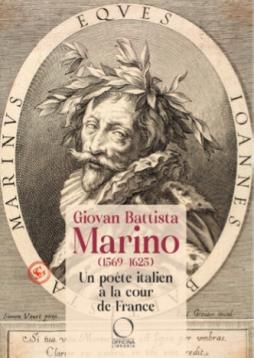
Giovan Battista Marino (1569-1625)
Un poète italien à la cour de France
Catalogue of the exhibition "Giovan Battista Marino (1569-1625) - An Italian Poet at the Court of France", presented at the Bibliothèque Mazarine, Paris (October 17, 2025 - January 17, 2026).
Giovan Battista Marino (1569-1625) is a singular and still little-known figure in Baroque poetry. While a taste for the marvelous and a touch of the extraordinary characterize his sonnets, his major work, Adone (1623), a long poem devoted to the love of Venus and Adonis, has elicited as much praise as criticism for its profusion, eroticism, and extravagance, far removed from the literary canons that would come to define the Grand Siècle.
Marino's life and work were nonetheless rich and cannot be reduced to a collection of "sometimes quite extravagant oddities" (Nicolas de Peiresc). Born in Naples, he entered the service of great Italian lords and cardinals, and found refuge in Paris in 1615, welcomed by the Regent Marie de Medici to escape the legal proceedings of the Inquisition.
After the assassination of Concino Concini (1617), he managed to maintain his position, skillfully navigating the tensions that accompanied the accession to power of the young Louis XIII. During these years in Paris, the "Cavalier Marin" amassed an exceptional collection of books, drawings, and engravings. Once his Adone (1623) was published, he returned to Italy and experienced a less prosperous period: shortly after his death, he gradually faded into obscurity, imposed both by Catholic propriety and by the difficulty of accepting such an unconventional poetic style.
Echoing the major exhibition held at the Galleria Borghese in Rome in 2024, marking the fourth centenary of his death, the Bibliothèque Mazarine, in partnership with the Sorbonne Nouvelle University and Sapienza University of Rome, is organizing the first exhibition in France entirely dedicated to Marino. To trace his significant role in literature and the arts, some fifty manuscripts, early editions, prints, drawings, and exquisite bindings are on display. Enriched by several essays, the catalogue reconstructs an extraordinary intellectual journey between Italy and France at the dawn of the Grand Siècle.