
News & Updates
A closer look: A Visit to the Library of Berlin's Deutsches Historisches Museum
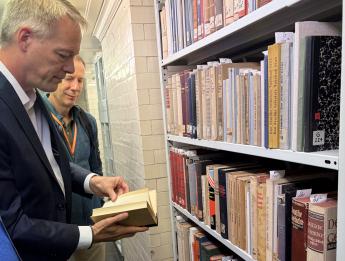
From rare military publications and eighteenth-century encyclopaedias to censored French caricatures and documents from Germany's National Socialist past, the tour demonstrated how books can serve as historical objects in their own right, offering insights into the political, social and cultural developments of their time.
The Deutsches Historisches Museum is one of Germany's most important institutions dedicated to the country's history. Its collections encompass an extraordinary range of historical material, including military objects, uniforms, flags, furniture, textiles, posters, prints, documents and everyday objects. Books occupy a particularly significant place within these collections.
As Dr Miller explained, the museum holds one of the largest collections of historical books within a German museum, with approximately 45,000 volumes forming part of its historical book collection. Unlike a conventional research library, the DHM collects books not only for the information they contain but also for their significance as historical artefacts.
The library also maintains a substantial reference collection supporting the museum's research, exhibitions and curatorial work. Its holdings are distributed across several storage areas, including spaces within the historic Zeughaus, Berlin's former armoury building.
With a relatively small team of librarians and library staff, the institution manages an extensive collection serving both researchers and the museum's wider activities.
From East German Military Library to National Museum Collection
The history of the library is closely connected to Germany's political history. The collection has its origins in the former Museum für Deutsche Geschichte in East Berlin, where military history and related publications formed an important part of the holdings.
Following the fall of the Berlin Wall in 1989 and German reunification in 1990, the collections of the former East German museum became part of the newly established Deutsches Historisches Museum.
Dr Miller recalled the extraordinary acquisition opportunities of the early 1990s, when the museum was provided with substantial funding at the time to expand its collections and allowing the museum to purchase historical objects and rare books on a scale that would be difficult to imagine today.
Today, acquisitions are naturally subject to considerably tighter financial constraints, but the legacy of those years remains visible throughout the library.
Rare Books, Encyclopaedias and Military History
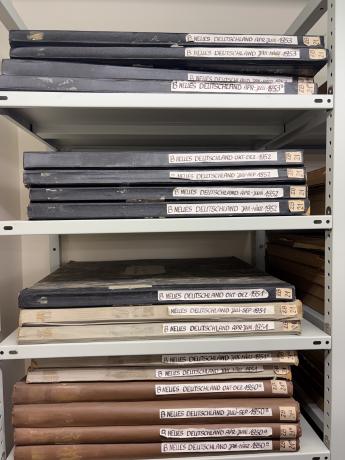
During the tour, delegates were taken into the library's holdings, where modern reference works stand alongside historical publications and rare editions.
Among the volumes pointed out were major encyclopaedic works, including Zedler's Grosses vollständiges Universal-Lexicon and the celebrated French Encyclopédie of Diderot and d'Alembert.
These monumental publications illustrate the breadth of the collection and its importance for understanding the intellectual and cultural history of Europe.
Particular attention was given to the library's holdings of historical military literature, reflecting the institution's origins and continuing collecting interests.
One of the objects presented was an illustrated publication depicting military uniforms from the period of Frederick William III of Prussia, dating from around 1800. With its hand-coloured illustrations, the volume offered an excellent example of how printed books can provide essential visual evidence for the study of military dress, insignia and material culture.
The "Giftschrank" or the "poison cabinet": Books from Germany's Difficult Past
One of the most thought-provoking parts of the visit concerned a section of the collection known in German as the Giftschrank, literally the "poison cabinet".
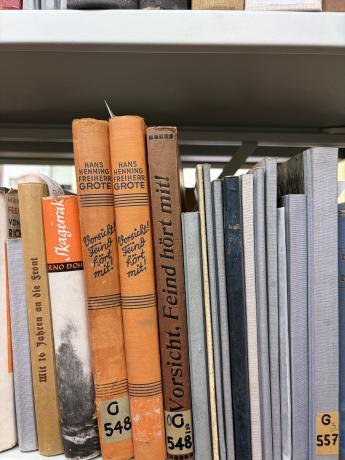
The term traditionally refers to restricted or sensitive publications, and in this case the shelves contain literature associated with Germany's National Socialist period.
Dr Miller showed delegates examples from the museum's collection of Mein Kampf, including special editions produced for particular purposes or recipients.
Among them were presentation editions and copies associated with the Nazi Party hierarchy, demonstrating how the book was used not only as a political text but also as an object of official representation and propaganda.
The collection also reflects the political history of the German Democratic Republic.
Dr Miller explained that the library also holds publications critical of communism and socialism, as well as works by political dissidents and authors whose writings were not freely accessible in East Germany.
A Rare Survivor: A Telephone Directory from the Nazi Leadership
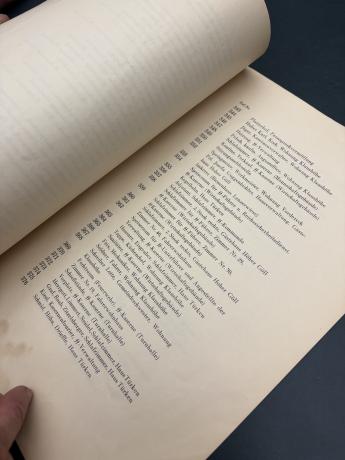
Among the particularly unusual objects presented was a telephone directory associated with the Nazi leadership at the Obersalzberg.
Dr Miller explained that only two copies of this publication are known to survive, one held at Stanford University and the other at the Deutsches Historisches Museum. The directory provides a remarkable insight into the administrative organisation of the Nazi regime, listing offices, individuals and their functions. Although an apparently ordinary reference publication, its historical importance lies precisely in the everyday administrative details it preserves.
The discussion then touched on the challenges of preserving and digitising such rare material.
Dr Miller explained that, as an object-based museum, the DHM has traditionally placed greater emphasis on the preservation and exhibition of physical artefacts than on large-scale digitisation. Nevertheless, digitisation remains an important consideration, particularly for unique or exceptionally rare documents.
Censorship and Caricature: An Extraordinary French Publication
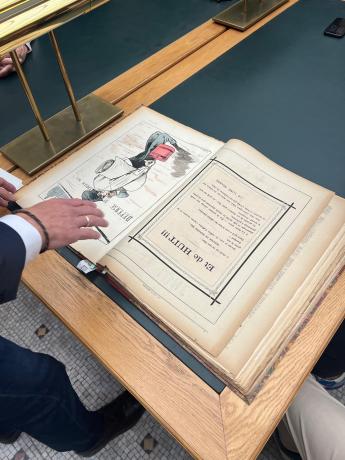
One of the highlights of the visit was a remarkable nineteenth-century French satirical publication containing caricatures by the celebrated artist André Gill.
Dr Miller explained that during the 1870s, French censorship authorities prevented several caricatures from appearing in print.
Rather than simply abandoning the material, the publishers responded with considerable ingenuity. In place of the prohibited illustrations, they published written descriptions of the images that readers would otherwise have seen.
The museum's copy is particularly extraordinary because it preserves material that was never included in the publicly distributed editions. Bound into the volume are original proofs and designs of the censored caricatures, providing a rare opportunity to see the images that the authorities had refused to allow into circulation. Among the subjects was the French writer Victor Hugo.
According to Dr Miller, these surviving proofs are exceptionally rare and are not even held by the Bibliothèque nationale de France.
Throughout the visit, Dr Miller emphasised the particular role of books within the Deutsches Historisches Museum. Unlike libraries primarily concerned with providing access to texts, the museum also considers the physical book as an object that can document historical events, political systems, artistic practices and social developments.
A military handbook, a propaganda publication, a telephone directory or a censored newspaper may appear very different in form and purpose, yet each can reveal something important about the society in which it was produced.
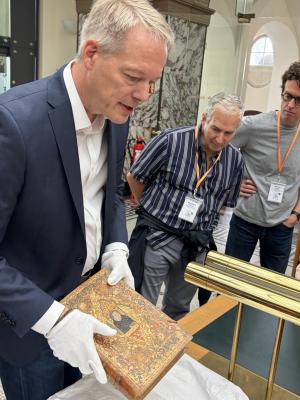
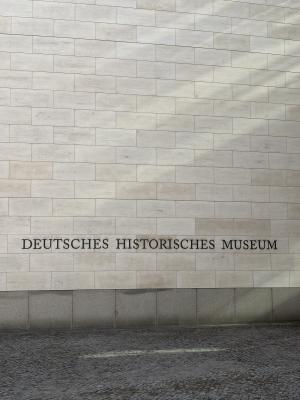
Our sincere thanks go to Dr Matthias Miller for welcoming the ILAB Congress delegates and sharing their knowledge of this fascinating collection.
The visit offered a rare opportunity to look behind the scenes of a major historical museum and to encounter books that, in many cases, have survived extraordinary circumstances.
Text and images: Angelika Elstner