News & Updates
Caxton and the Revolution of Print in England
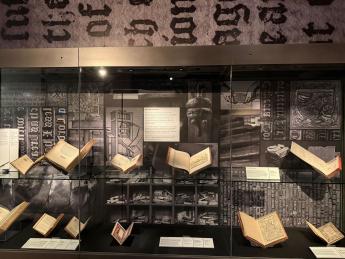
Books in England were still being written by hand when, in mid-15th-century Germany, Johannes Gutenberg developed printing with movable type. Within a remarkably short time, this new technology spread across continental Europe, increasing production and lowering the cost of books.
William Caxton encountered printing on the continent, in Cologne and Bruges, before bringing it to England in 1476. Over the course of his career he produced around ninety books, some seventy-four of them in English. That choice alone was transformative: print did not simply reproduce texts, it helped stabilise and standardise the English language itself.
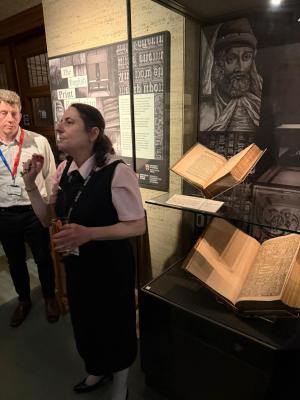
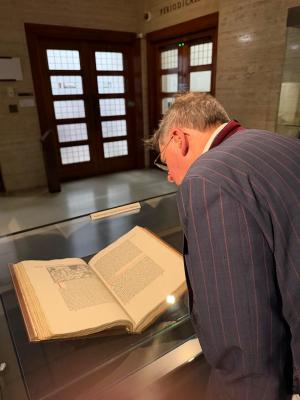
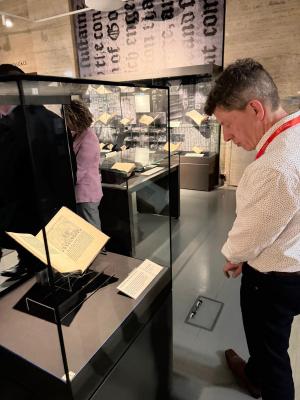
Yet Caxton’s books were not “modern” in appearance. As the exhibition at Senate House Library makes clear, they were deliberately designed to resemble manuscripts familiar to readers. They were printed in black letter, without title pages, and illustrated with woodcuts that, while effective, lacked the precision of later engraving. Readers were given little navigational help, page numbers, running titles and indexes were largely absent. In many ways, these books still belonged to a manuscript culture, even as they marked the beginning of something entirely new.
The exhibition The English Print Revolution: Caxton and Beyond shows how print rapidly expanded its reach and purpose. It reshaped how people encountered faith, history, politics, science and language. Printed books did not simply transmit knowledge, they conferred authority, promoted ideologies, and mobilised readers across social ranks.
State-sponsored works such as the Great Bible or Holinshed’s Chronicles presented authorised visions of religious belief and English nationhood. At the same time, cheaper formats, plays, pamphlets and newsbooks, circulated more controversial or contested ideas to a far broader audience. Alongside these, large-scale reference works, from herbals to dictionaries, attempted something equally ambitious: the organisation and dissemination of knowledge.
The exhibition also traces how the physical book evolved. Later editions of texts first printed by Caxton reveal the gradual refinement of layout, typography and illustration. Caxton himself never faced certain technical challenges, such as printing music or non-Roman scripts, that continental printers were already beginning to tackle. After his death, these developments accelerated, and the scope of print culture broadened dramatically.
One particularly telling section of the exhibition reflects on the long-term trajectory of book production. Early printed books were, in fact, cheaper than manuscripts while still being finely made objects, produced with handmade paper, ink and type. By the nineteenth century, mechanisation made books widely affordable, but often at the cost of quality. The tension between accessibility and craftsmanship led to a reaction from private presses, which returned to producing books that were beautiful, but necessarily more expensive. In this sense, the history of print comes “full circle”.
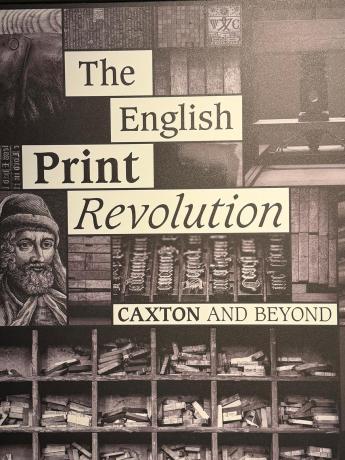
Senate House Library, one of the UK’s leading research libraries, holds exceptional collections relating to early printing and the history of the book. This current exhibition offers a rare opportunity to see these developments traced through original material.
Firsts: London’s Rare Book Fair is proud to partner with Senate House Library as its charity partner for 2026. The collaboration brings together the rare book trade and one of London’s most important scholarly institutions.
For more information about the fair, please go >> HERE
We highly recommend visiting the exhibition when in London: >> THE ENGLISH PRINT REVOLUTION - CAXTON AND BEYOND
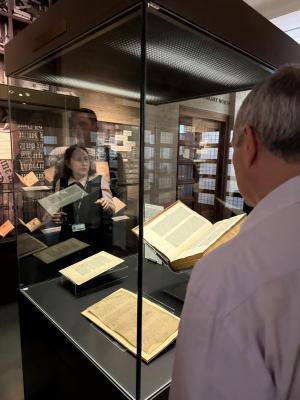
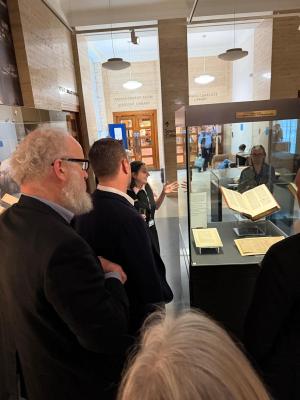
Members of the Antiquarian Booksellers’ Association were recently honoured to receive a personal guided tour of the current exhibition by Dr Karen Attar, Curator of Rare Books and University Art.