
Actualités
"at the forefront of promoting culture by vocation"
The Magic of the Marketplace
Owing to the rising costs of stand set-up, transport, customs clearance, insurance and even accommodation, for some years now antiquarian book fairs can no longer be regarded as mere markets designed to ‘turn a profit’. Taking part in our international fairs does, in fact, entail the risk of an immediate financial loss, especially overseas. However, it offers the certainty of making face-to-face contact, within the space of just a few days, with colleagues, collectors and library curators whom one would otherwise only meet over the course of entire months of work. These fairs have, in essence, become ‘places of reputation’, just as is the case in the wider art market (TEFAF, Art Basel, Frieze Masters), where participation in extremely costly events generates relational capital even more than economic capital1.
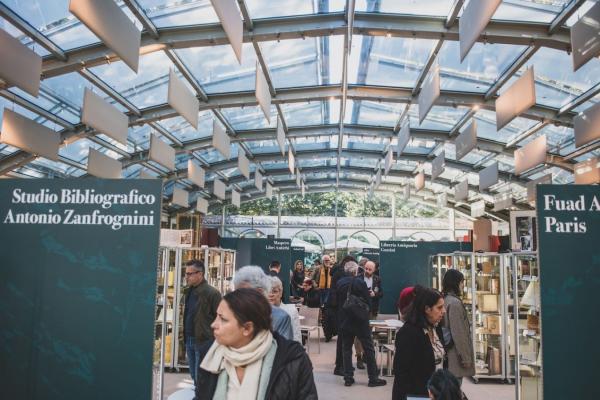
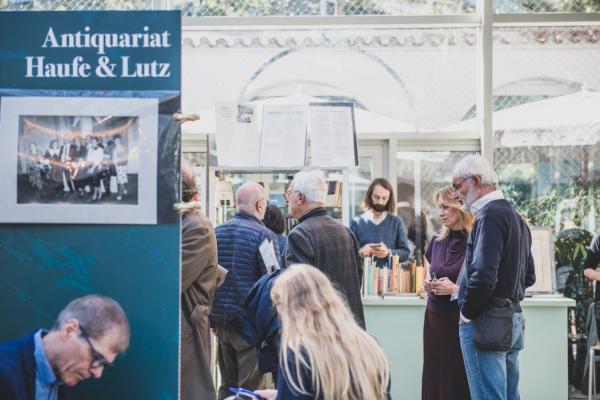
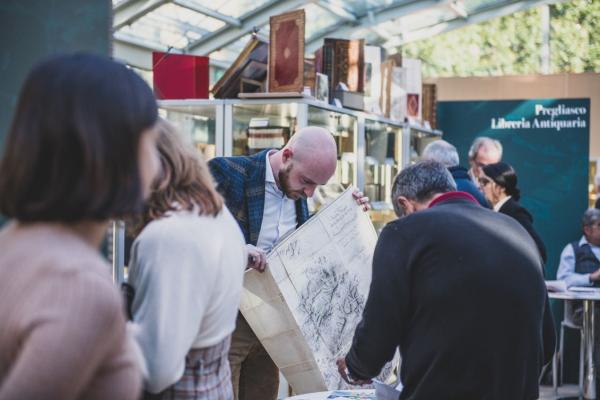
For this reason, taking the initiative early on, the Italian Association of Antiquarian Booksellers (ALAI) has, for the past four years, been organising a rare book fair in Milan designed to captivate and welcome visitors: a boutique fair, held in October in collaboration with the FAI within the setting of Villa Necchi Campiglio, a historic residence of Rationalist charm. It is an event where spaces sell out within a few hours of registration opening and which, at the end of each iteration, receives increasingly encouraging feedback. With its carefully curated and attractive selection of displays (42 exhibitors), the Mostra del Libro Antico e Raro is now regarded as a well-established Italian event, at times evoking the collective memory of the first fairs held at the Palazzo delle Stelline (39 exhibitors in 1980)2 and the Palazzo della Permanente (45 exhibitors in 1990)3.



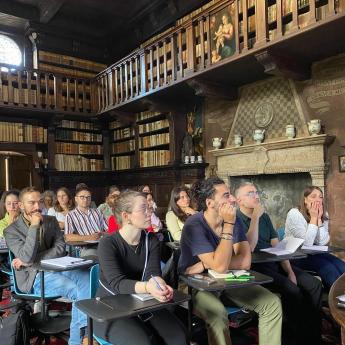
With a view to the 2027 edition, to further enrich the programme, the Association has also proposed hosting the ILAB Presidents’ Meeting in Milan, which the International League of Antiquarian Booksellers (LILA-ILAB) organises annually in a different city around the world. The international committee and the presidents of the national associations will arrive at Malpensa or Linate the preceding weekend: they will hold their meetings in the halls of the Bianca Maria Palace Hotel (a stone’s throw from Via Mozart), visit the city’s main book-related institutions and be among the distinguished guests at the exhibition at Villa Necchi Campiglio. We have already made arrangements to organise exclusive visits to the treasures of Milan’s most prestigious libraries (Braidense, Trivulziana, Ambrosiana) and, amongst various ideas, we have considered accompanying the delegation to the charming library of the Ugo Da Como Foundation in Lonato del Garda (Brescia), which for the past two years has been home to a rare book school that we sponsor4.
The vast majority of historic book-preservation institutions were, in fact, established over the centuries precisely thanks to enlightened collectors who drew upon the antiquarian market to build up their collections. A prime example of this is the Braidense National Library: founded by Empress Maria Theresa of Austria in 1770, it nevertheless owes its original core collection to the 24,000 volumes belonging to Count Carlo Pertusati, acquired from his heirs, to which other collections were added over time. I cite the library of the scientist Albrecht von Haller, the military works of Colonel Nicolò Baschiera, the collection of Cardinal Angelo Maria Durini, a portion of the prestigious collection of the bibliophile Carlo Morbio, and furthermore, the Manzoni-related collections of the banker Pietro Brambilla, culminating more recently with the antiquarian books of the renowned semiotician – and friend of the ALAI – Umberto Eco. From countless stories such as this, it is clear that the antiquarian book market – left to its own dynamic initiative – has always been the fundamental and vital pillar of the public bibliographic heritage5. Indeed, to quote a famous American saying, it would seem that there ‘really is something magic about the marketplace when it’s free to operate’6.
We know, however, that this liberal approach to the market for antiquarian and rare books – shared not only by bibliophiles but also by many Northern European institutions – contrasts with the orientation of the cultural schools of thought currently dominant in Italy7. These schools of thought set ‘protection’ in abstract opposition to so-called ‘valorisation’, and thus the public against the private, as if these were two irreconcilable concepts. The doctrine of valorisation would inevitably be interpreted as the extraction of economic value from public cultural heritage by private individuals, and thus opposed.
Above all, however, it is clear that this alternative cultural approach perceives collecting as a predatory rather than a virtuous activity, assuming that the antiquarian bookseller acts as an incentive for the plundering of historic libraries – usually ecclesiastical or aristocratic – rather than as a fundamental ally in the creation of the finest public collections.
‘Why do you, having graduated with first-class honours, want to do this job?’ a civil servant asked me with enlightening naivety and candour at the start of my professional career. At the time, I blushed indignantly; today I would reply that it is precisely the antiquarian bookseller – driven by a love of books and, yes, by legitimate profit, which no institution has the right to demonise – who is at the forefront of promoting culture by vocation, often remedying the oversights of history and politics. In other words, he tracks down lost volumes, uncovers them, studies them, showcases them, makes them public and, ultimately, makes them tangibly accessible, salvaging what families or institutions of the past failed to preserve or deliberately discarded. For this reason, our profession deserves gratitude, moving beyond that veil of suspicion unjustly fuelled by isolated bad cases, which I would leave to the literature of criminal law. It is therefore essential that the Superintendencies, whilst rigorously overseeing conservation, collaborate with us to help the public understand that there is no contradiction between the categorical defence of cultural heritage and openness towards our transparent market. Effective protection does not stem from the elimination of the market – as I have even heard claimed in certain circles – but from its harmonious growth, given its indisputable effectiveness in enhancing cultural heritage. Even where there are shortcomings, the antiquarian book trade embodies an inherent goodness that institutions should safeguard and facilitate.
In this regard, I would like to commend the Soprintendenza Archivistica e Bibliografica della Lombardia for the significant improvements it has made to the management of export paperwork. From 4 May 2026, in fact, the Ministry of Culture has separated the management of book heritage from that of works of art with regard to their movement, finally bringing into operation across the country six Export Offices dedicated specifically to books and prints (Turin, Milan, Venice, Florence, Rome and Naples)8. Whilst at central level – despite the constant efforts of the ALAI and the Apollo Group9 – the focus has often centred on the legal and technical debate surrounding proposals for the Digital Passport and amendments to Ministerial Decree 246/2018, the Soprintendenza of Lombardy has opted for a pragmatic approach. By introducing the digital issuance of documents and fostering fruitful collaboration with users, Milan has been able to seize the opportunity presented by this change and promptly resolve some of the operational challenges that, unfortunately, continue to weigh heavily on the rest of Italy. This management model, whilst alleviating some minor bureaucratic burdens on operators, simultaneously streamlines the work of the offices themselves, demonstrating that a concrete alternative to red tape is not only possible but highly desirable. As a trade association, whilst confident in the excellent results of national political lobbying, particularly this year10, we wholeheartedly support this local approach, which stems from daily engagement with the real dynamics of the market and a genuine synergy between professionals and Lombardy officials who, at least as far as the processing of paperwork is concerned, are in the same boat.
In conclusion, whilst we defend the rights of our profession tooth and nail, we at ALAI also support the commitment of public authorities who work efficiently to ensure that things run smoothly. We are, in fact, convinced that regional solidarity is now an indispensable resource, at a time in history when many sectors are facing an increasingly complex regulatory framework and, as far as the protection system is concerned, one that is at times ideologically specious.
This article was originally published in Italian in the ALAI annual book-collecting magazine Rivista di Cultura del Libro, no. 12-2026, pp. 181–184.
It is reposted here in English translation with the permission of the author and the Italian Antiquarian Booksellers' Association (ALAI).
1 GINEVRA BORROMEO, Stand, trasporti, hotel, allestimenti. Crisi o meno le fiere d’arte stanno diventando un lusso? L’inflazione che cambia il mercato, in Il giornale dell’arte del 29 giugno 2026.
2 Mostra Mercato del Libro e della Stampa Antichi - Palazzo delle Stelline, Milano, 3-5 Maggio 1980, Milano, L’Esopo, 1980.
3 Mostra del Libro e della Stampa Antichi - Palazzo della Permanente, Milano, 29 marzo-1 aprile 1990, Milano, Edizioni Rovello, 1990.
4 Scuola estiva «Luigi Nocivelli» di Lonato del Garda (BS), Fondazione Ugo Da Como e CRELEB, Università Cattolica del Sacro Cuore, Casa del Capitano alla Rocca.
5 Regarding this, I refer to what was published in MINISTERO DELLA PUBBLICA ISTRUZIONE, Notizie storiche, bibliografiche e statistiche sulle Biblioteche Governative del Regno d’Italia pubblicate in occasione del Congresso Internazionale dei Bibliotecari (Chicago, luglio 1893), Roma, Tipografia Elzeviriana, 1893.
6 RONALD WILSON REAGAN, President Reagan’s First Radio Address on the Economic Recovery in the Oval Office, April 3, 1982, in https://www.reaganlibrary.gov/.
7 It is enough to recall, in this regard, the pages of TOMMASO MONTANARI, Chiese chiuse, Torino, Giulio Einaudi Editore, 2021.
8 Decreto del Dipartimento per la Tutela del Patrimonio Culturale n. 35 del 9 aprile 2025.
9 On March 30, 2026, the General Assembly of the Apollo Group unanimously approved the Board of Directors' proposal to welcome ALAI among the associations comprising its membership, granting it the right to participate in the assembly and to vote.
10 Legge 17 marzo 2026, n. 40, Modifiche al codice dei beni culturali e del paesaggio, that contains, among the matters of interest to the antiquarian booksellers: the extension of DVAL validity to 5 years, the option to withdraw an ongoing ALC application, and the limitation of ALC refusals for works by foreign authors to specific, circumscribed cases.
Images by Francesca Marelli for ALAI